Cattle & horse pastures
Strong boundary fencing for grazing land and paddocks.


Livestock Fencing
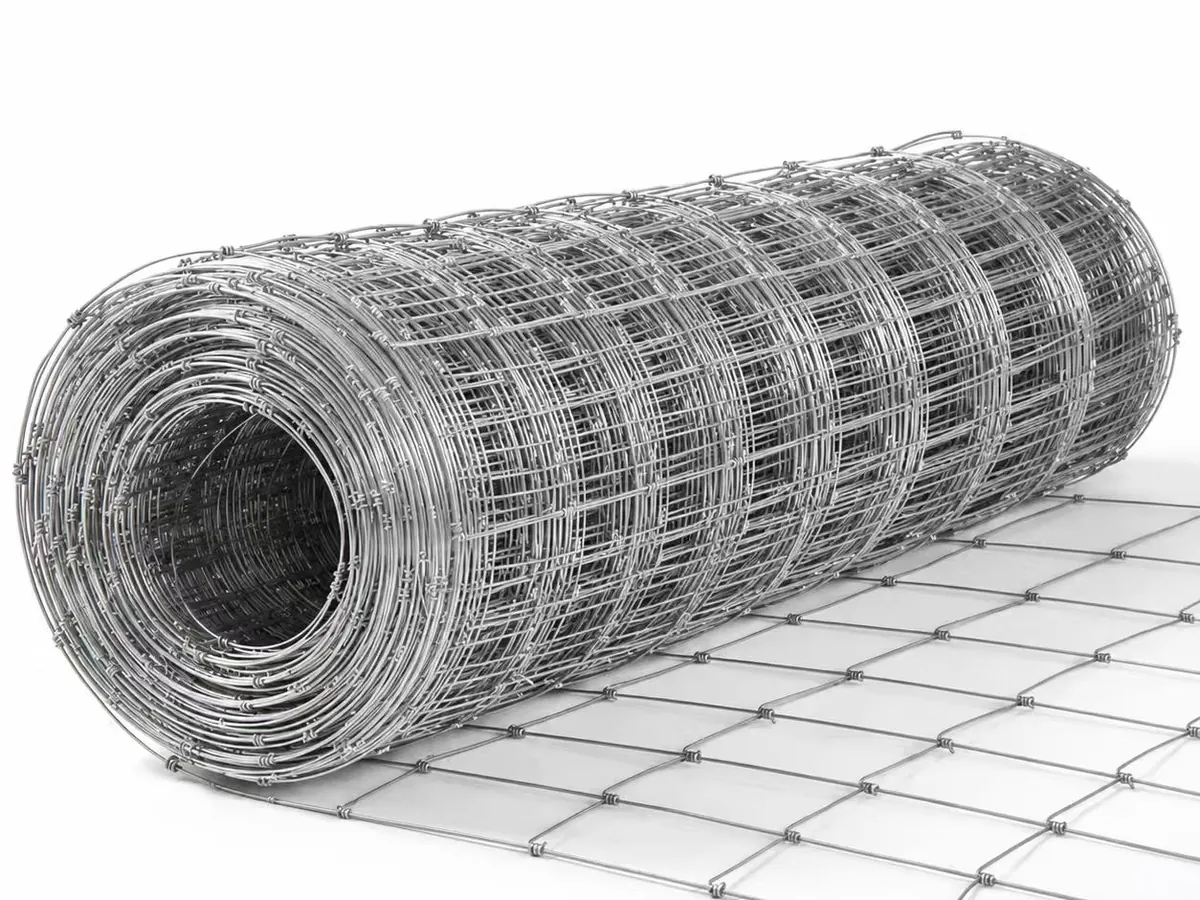
Cattle fence, also known as field fence, hinge joint fence or grassland fence, is a woven livestock fence of horizontal line wires and vertical stay wires joined by knots, with smaller openings at the bottom and wider openings at the top.
Graduated mesh for cattle, sheep, goats and deer. Custom heights, wire sizes and roll lengths available.
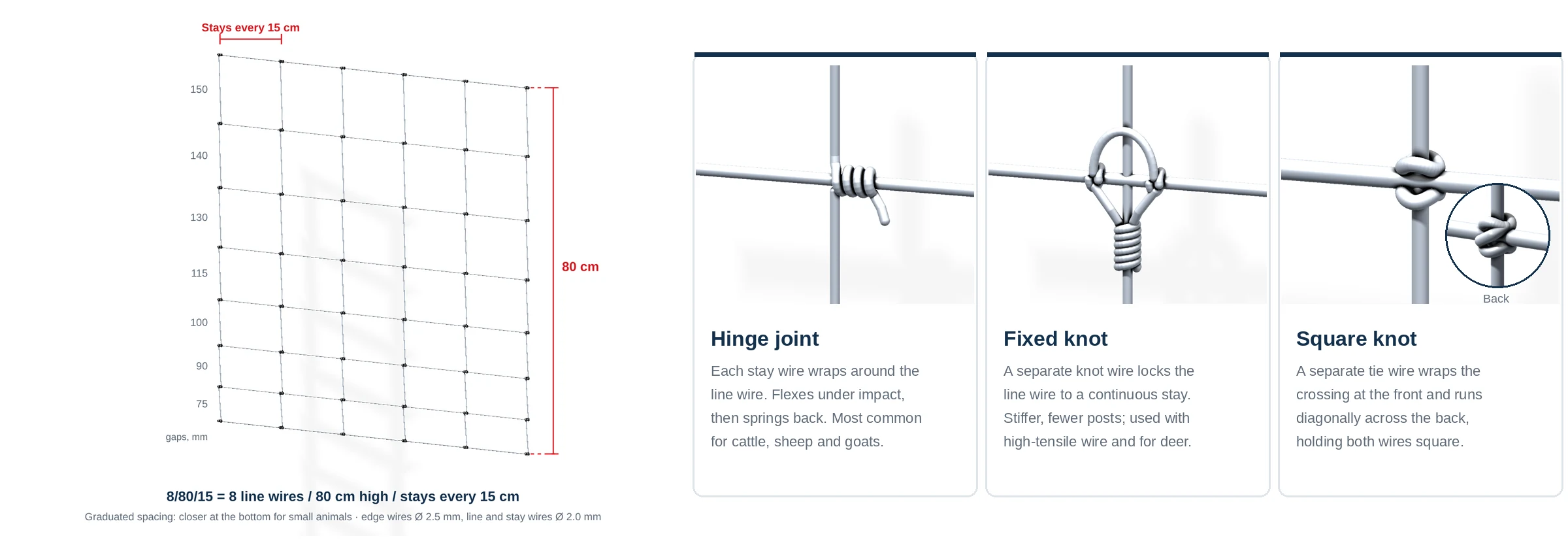
Cattle fence is woven from horizontal line wires and vertical stay wires that are wrapped together with a knot at each crossing. The line wires are closer together at the bottom, to stop small animals passing through, and wider at the top, which saves wire where it is not needed.
Specifications are written as line wires / height / stay spacing. For example, 8/80/15 means 8 line wires, 80 cm high, with stays every 15 cm. Closer stays make a stronger fence for smaller or more active animals.
Hinge joint knots let the fence flex under impact and spring back, and suit most farms. Fixed knot fences are stiffer, need fewer posts and are used with high-tensile wire for long runs and wildlife. Square knot fences use a separate tie wire that holds each crossing square and is common in North American field fence.
Tap the image to view full size
Standard configurations for livestock fencing.
| Item | Standard specification |
|---|---|
| Fence height | 600 / 800 / 1000 / 1200 / 1500 / 2000 mm |
| Line wires | 6–17, graduated spacing (closer at the bottom) |
| Common types | 6/80/30, 8/80/15, 8/100/30, 9/120/30, 13/150/15, 17/200/15 |
| Vertical stay spacing | 150 mm or 300 mm |
| Edge wire (top & bottom) | 2.5 mm (2.5–3.0 mm available) |
| Line & stay wire | 2.0 mm (1.9–2.5 mm available) |
| Knot type | Hinge joint; fixed knot; square knot |
| Roll length | 50 m or 100 m |
| Wire | Low-carbon or high-tensile steel wire |
| Finish | Hot-dip galvanized; Zn-Al alloy available |
| Packing | Rolls with steel wire ties and labels, palletized or loose; custom packing on request |
Custom heights, number of line wires, spacing, wire sizes, knot types and roll lengths are available. Send the animal type, fence height and total length for a quotation.
Strong boundary fencing for grazing land and paddocks.
Closer bottom spacing keeps smaller animals contained.
Tall fences for deer farms, forestry and road protection.
Economical fencing for plantations, orchards and smallholdings.
8 horizontal line wires, a fence height of 80 cm, and vertical stays spaced 15 cm apart.
Hinge joint knots let the fence flex and spring back under pressure. Fixed knots wrap a separate wire around each crossing, making a stiffer fence that needs fewer posts. A square knot uses a separate tie wire that wraps the crossing at the front and runs diagonally across the back, keeping both wires square.
Smaller openings near the ground stop young and small animals getting through, while wider openings at the top keep the fence economical.
150 mm stays suit sheep, goats and smaller animals. 300 mm stays are enough for cattle and horses.
High-tensile wire stretches less, so the fence stays tight over longer runs with fewer posts. Low-carbon wire is easier to handle and repair.
Animal type, fence height, number of line wires, stay spacing, knot type, roll length, quantity, and the destination port.