Farm & ranch boundaries
Livestock fencing for pastures, ranches and plantations.


Perimeter & Farm Wire
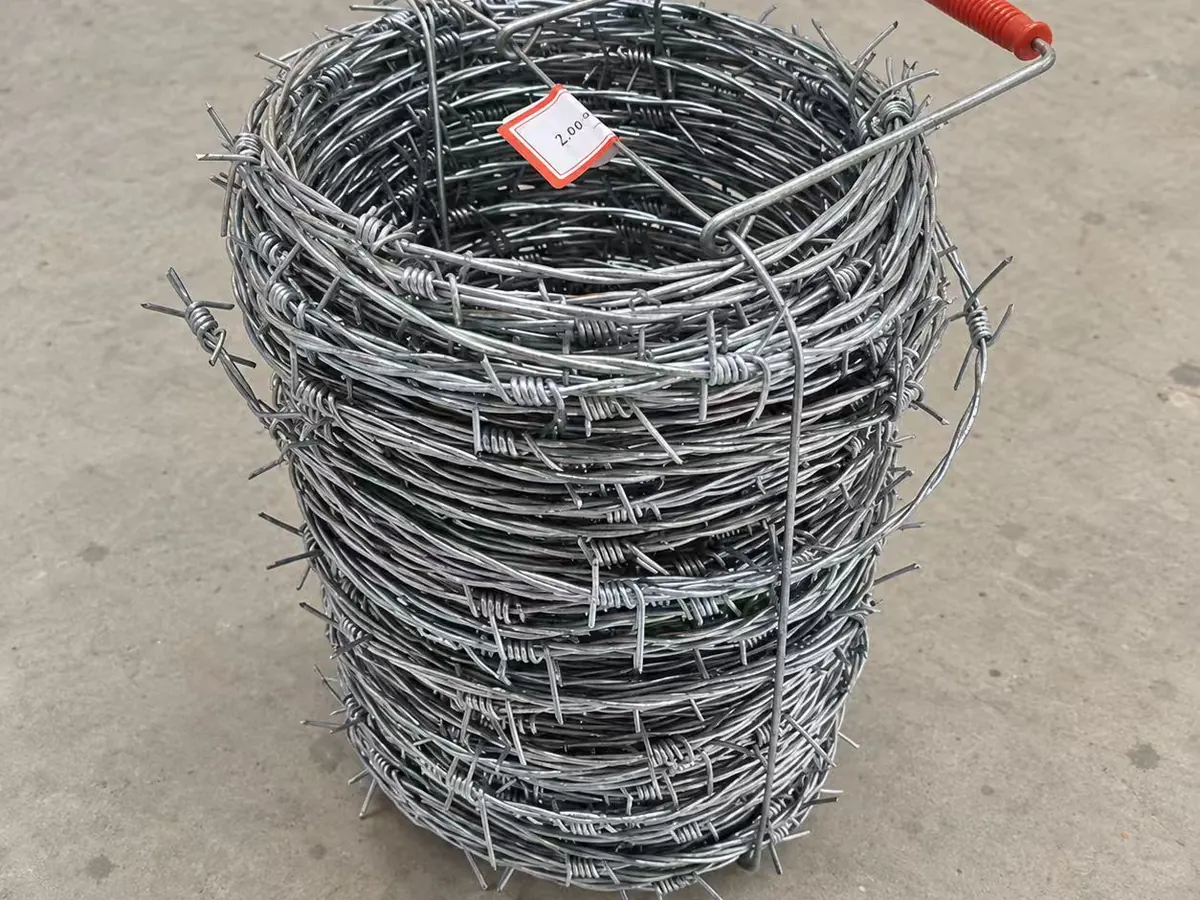
Barbed wire is a fencing wire made of one or two twisted line wires with short sharp barbs wrapped around them at regular intervals, used to deter people and animals from crossing a boundary.
Double-twist, reverse-twist and single-strand types. Custom wire sizes, spacing and coil weights available.
Barbed wire is made by twisting two line wires together and wrapping short barb wires around them at fixed spacing, leaving four sharp points at each barb. It is the most economical way to add a barrier along farm boundaries or the top of a security fence.
There are three common constructions. Conventional double twist has barbs wound around both line wires. Reverse twist alternates the twist direction at every barb, so the barbs cannot slide. Single strand uses one line wire and is lighter for animal control.
Wire is electro-galvanized or hot-dip galvanized for outdoor use, or PVC coated in green or other colours. Coils are supplied by length or by weight to suit your market.
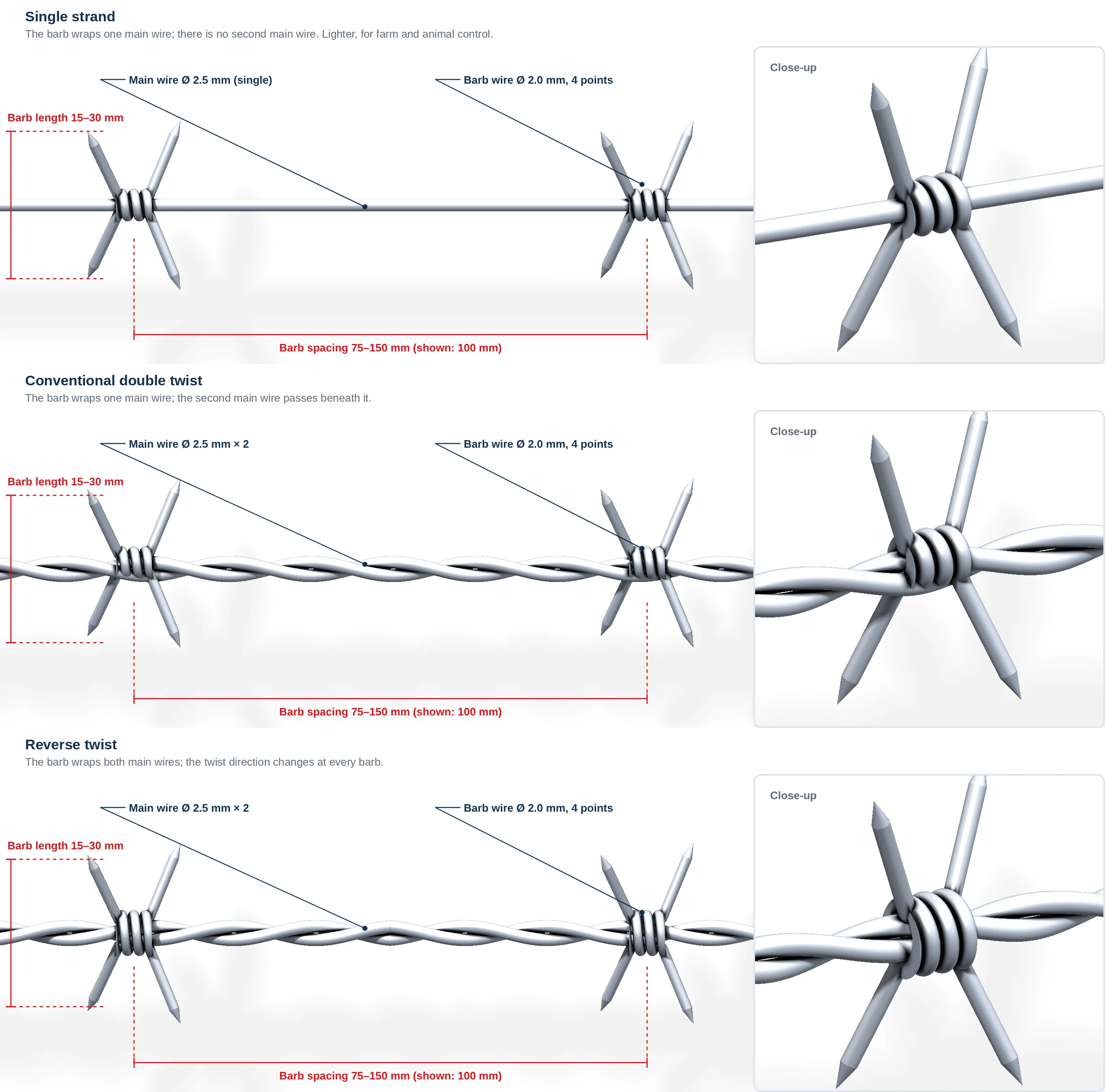
Tap the image to view full size
Standard configurations by type and wire size.
| Item | Standard specification |
|---|---|
| Construction | Conventional double twist; reverse twist; single strand |
| Line wire diameter | 1.6–2.8 mm; common 2.5 mm (BWG 12) |
| Barb wire diameter | 1.6–2.2 mm; common 2.0 mm (BWG 14) |
| Common gauge pairs | BWG 12 × 12, 12 × 14, 14 × 14, 14 × 16, 16 × 16 |
| Barb spacing | 75–150 mm; common 100 / 127 / 150 mm |
| Barb length | 15–30 mm |
| Barb points | 4 points |
| Coil length | 100 / 200 / 250 / 400 / 500 m, or by weight (e.g. 25 / 50 kg) |
| Material | Low-carbon steel wire; high-tensile wire available |
| Finish | Electro-galvanized; hot-dip galvanized; PVC coated over galvanized wire |
| PVC colours | Green, blue; other colours on request |
| Packing | Coils with or without wooden or plastic handle, wrapped in plastic film; palletized; custom packing on request |
Custom wire sizes, barb spacing, coil lengths and weights, finishes and packing are available. Send your wire sizes, barb spacing, coil length and quantity for a quotation.
Livestock fencing for pastures, ranches and plantations.
Extra strands on top of mesh and palisade fences.
Low-cost barriers for camps, borders and restricted zones.
Perimeter deterrent for yards, depots and construction sites.
In conventional twist the line wires twist in one direction and barbs are wrapped between them. In reverse twist the twist direction changes at each barb, which locks the barbs in place.
It is the wire gauge pair: a BWG 12 line wire (about 2.5 mm) with a BWG 14 barb wire (about 2.0 mm). Please also give sizes in millimetres when ordering.
By coil length (for example 200 m or 400 m) or by coil weight. Tell us which your market uses and we will pack accordingly.
Hot-dip galvanized gives the longest outdoor life. PVC coating adds colour and extra protection, and is often chosen for residential and visible areas.
Yes. It is commonly fixed on extension arms on top of mesh, chain link and palisade fences.
Construction type, line and barb wire diameters, barb spacing, finish, coil length or weight, quantity, and the destination port.