Security Screen Mesh Guide
Square-Hole vs Round-Hole Security Screen Mesh: Airflow, Light, Insects and Security
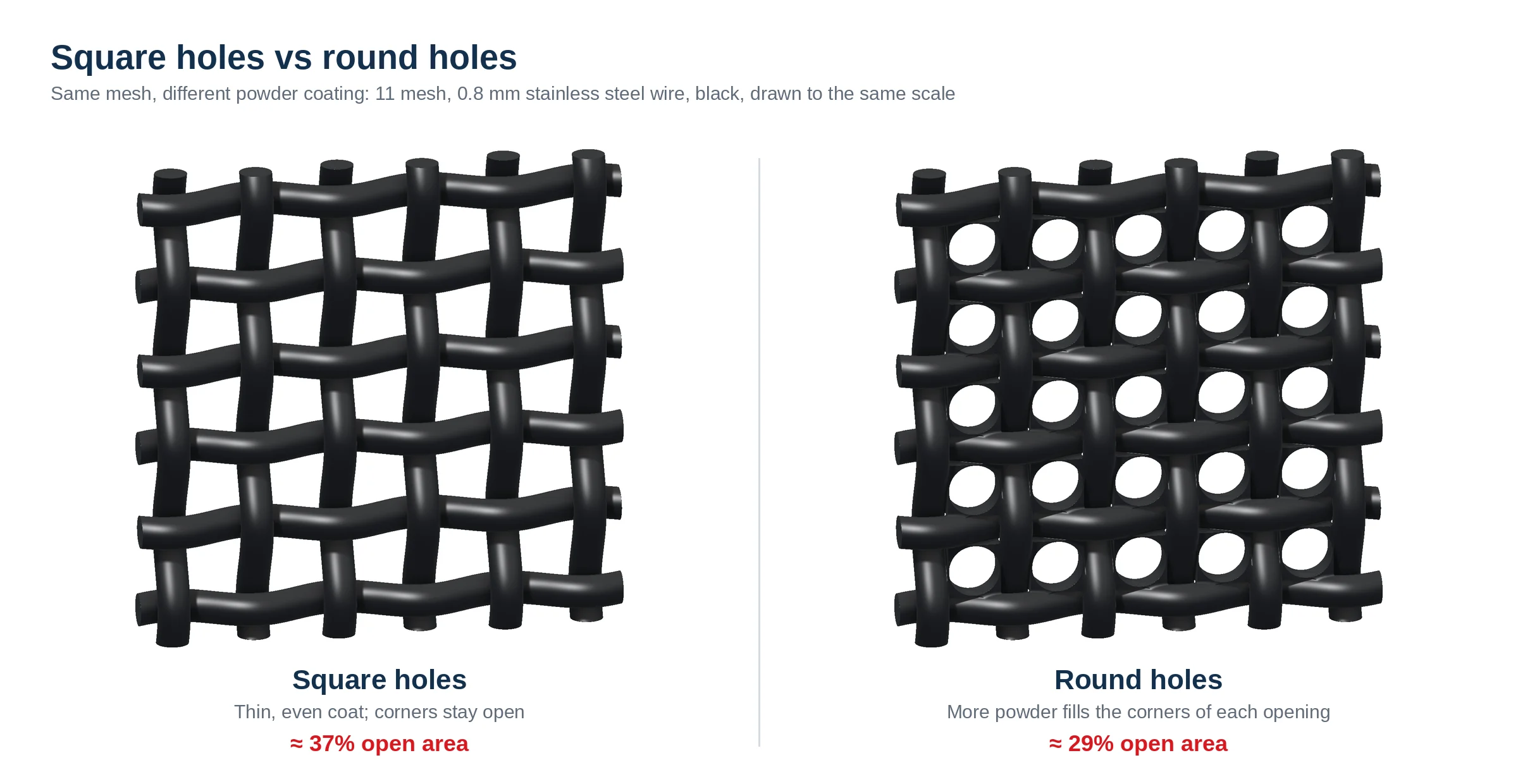
Powder-coated security screen mesh can be finished with square holes or round holes. The wire and weave are the same; the coating is not. Here is how the two finishes compare, with open-area figures for 0.8, 0.9 and 1.0 mm wire.
Key takeaways
- Square-hole and round-hole security mesh use the same stainless steel wire and weave. The difference comes from the powder coating: round holes use a different powder and more of it, so the powder fills the corners of each opening.
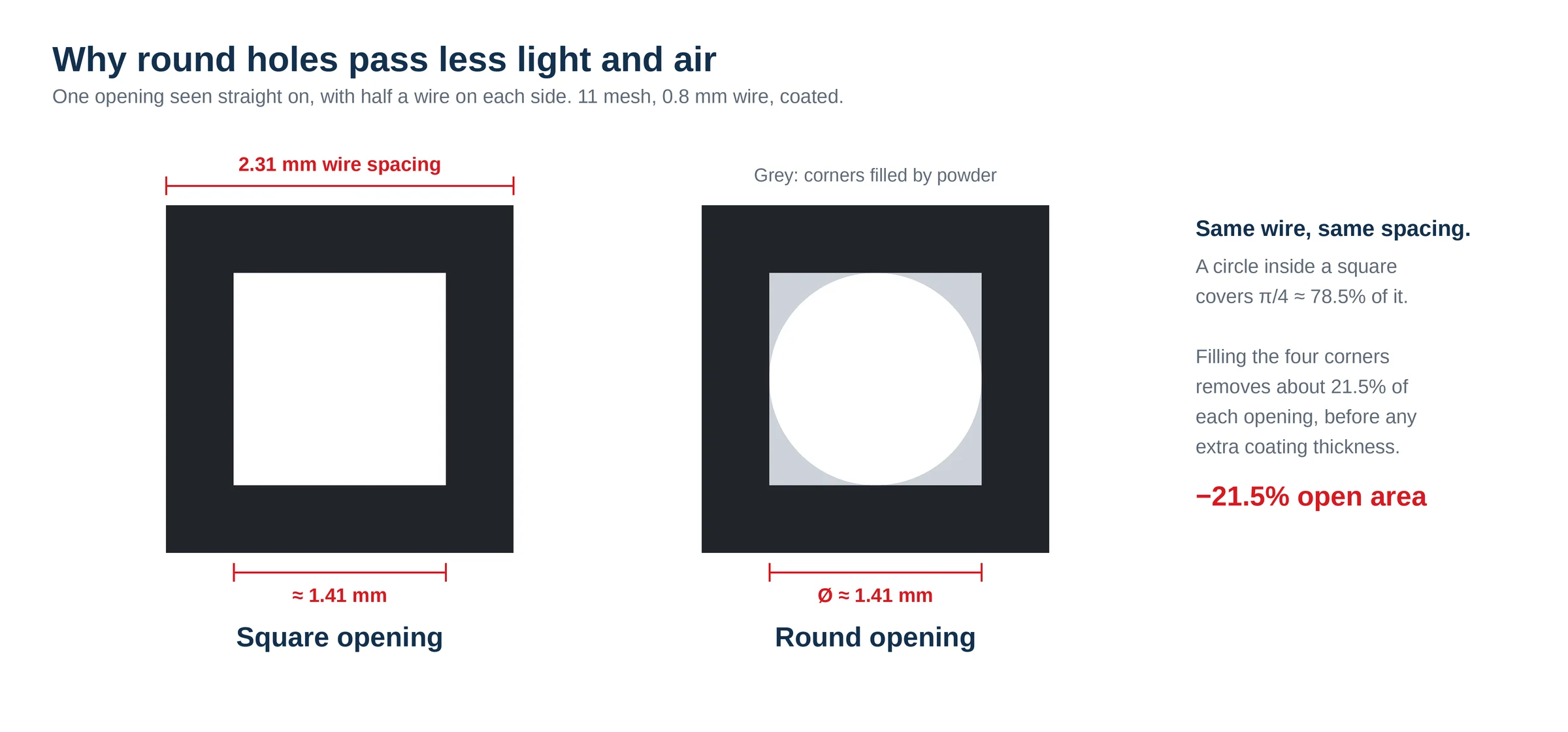
- A round opening covers about 78.5% of the square opening it sits in. Round holes therefore let through about 21% less light and air than square holes on the same mesh.
- On 11 mesh with 0.8 mm wire, that is about 37% open area for square holes and about 29% for round holes.
- Insect protection is about the same: the narrowest gap, which decides what can pass, is the same width in both.
- Hole shape does not change the steel. Cut and impact resistance come from the wire diameter, the stainless steel grade and the complete screen system.
Contents
What are square-hole and round-hole security mesh?
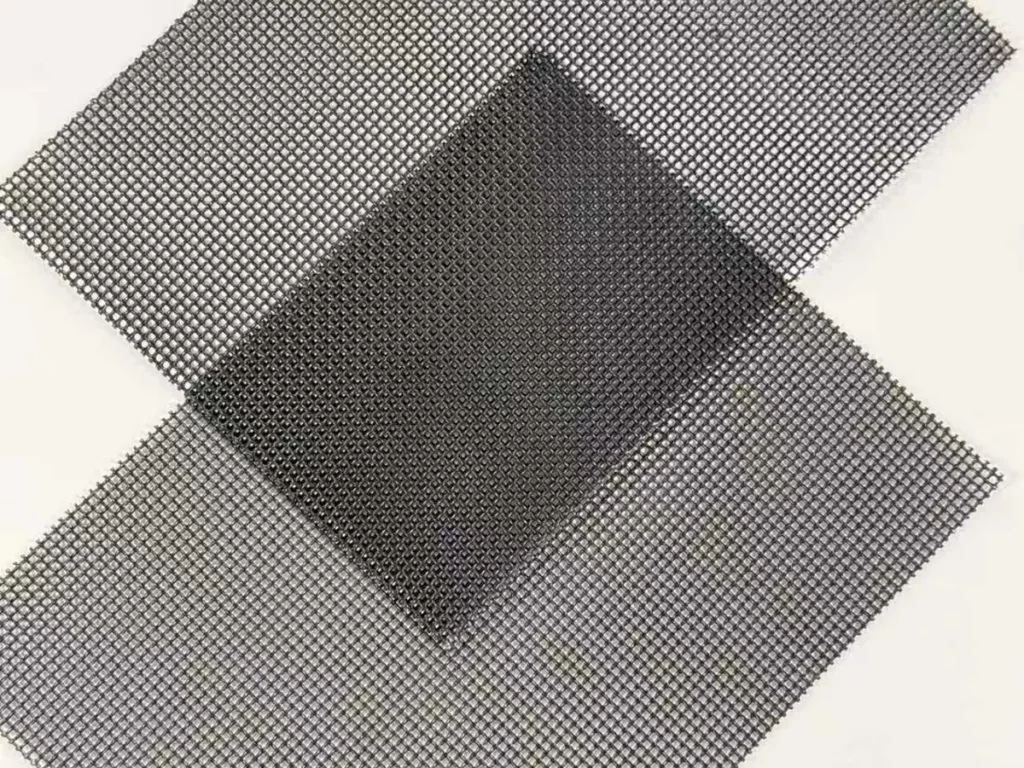
Security screen mesh is a heavy plain-weave stainless steel mesh, usually 11 mesh with 0.8 mm wire, finished with polyester powder coating. In a plain weave the wires cross at right angles, so the bare mesh always has square openings. Whether the finished mesh shows square or round holes depends on how it is coated.
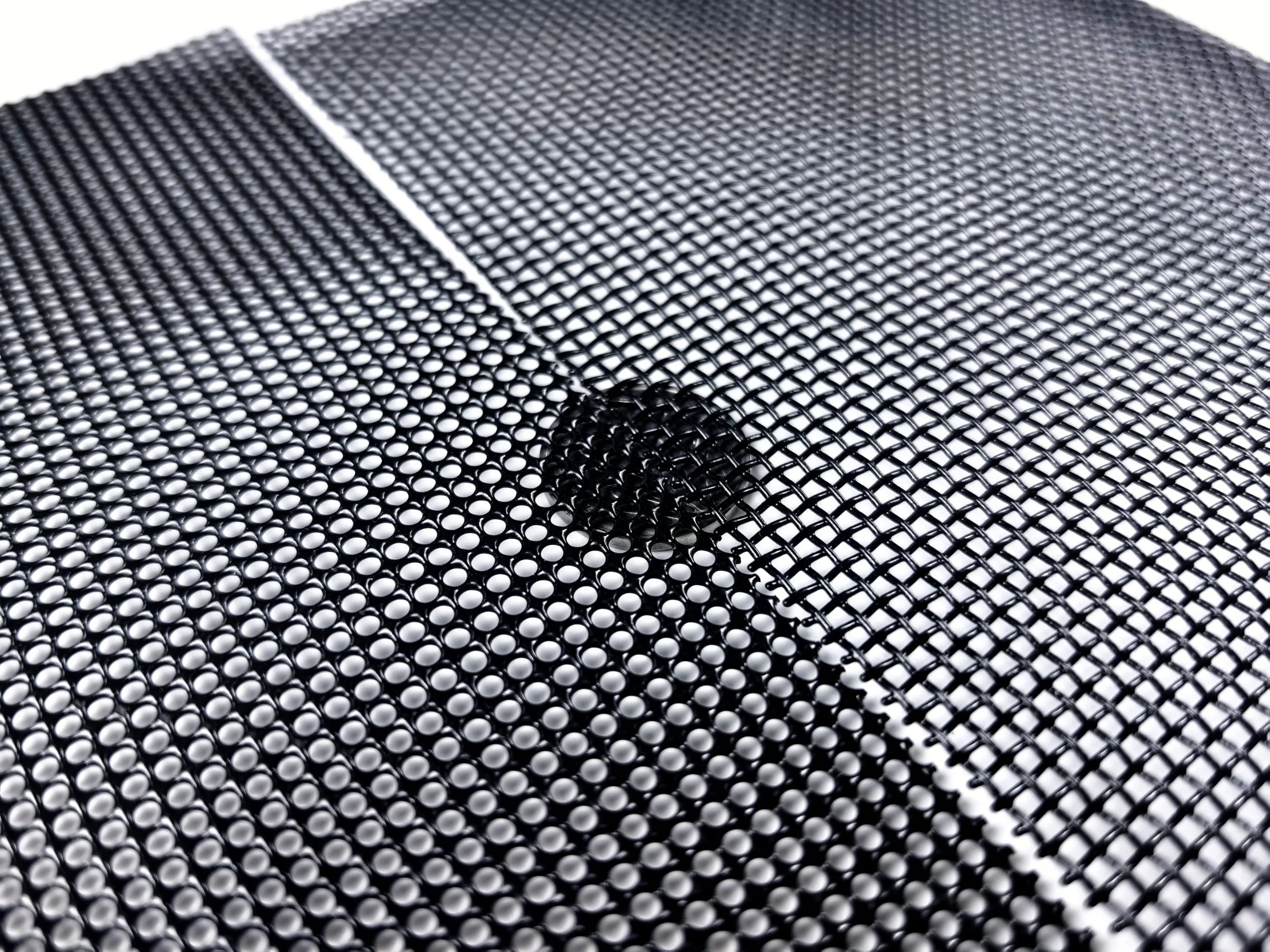
- Square holes: a thin, even powder coat follows the round wire. The corners of each opening stay open, so the holes remain square.
- Round holes: a different powder is applied in a larger quantity. The extra powder collects where the wires cross and fills the four corners of each opening, leaving a round hole.
Both finishes are applied in a single coat, and the manufacturer chooses which one to produce. You can tell them apart by eye: hold a sample up to the light.
Round holes came first. Heavy-wire security mesh was traditionally supplied with round holes; square-hole finishes on heavy wire have only appeared in recent years. Today both are available, and we produce either finish to the customer’s specification.
Why round holes let through less light and air
Hole shape is a matter of simple geometry. A circle drawn inside a square covers π/4 of the square’s area, about 78.5%. When powder fills the four corners of an opening, about 21.5% of that opening is closed.
The width across the opening does not change. A round hole has the same diameter as the side of the square hole it replaces. Only the corners are lost.
Open area by wire diameter
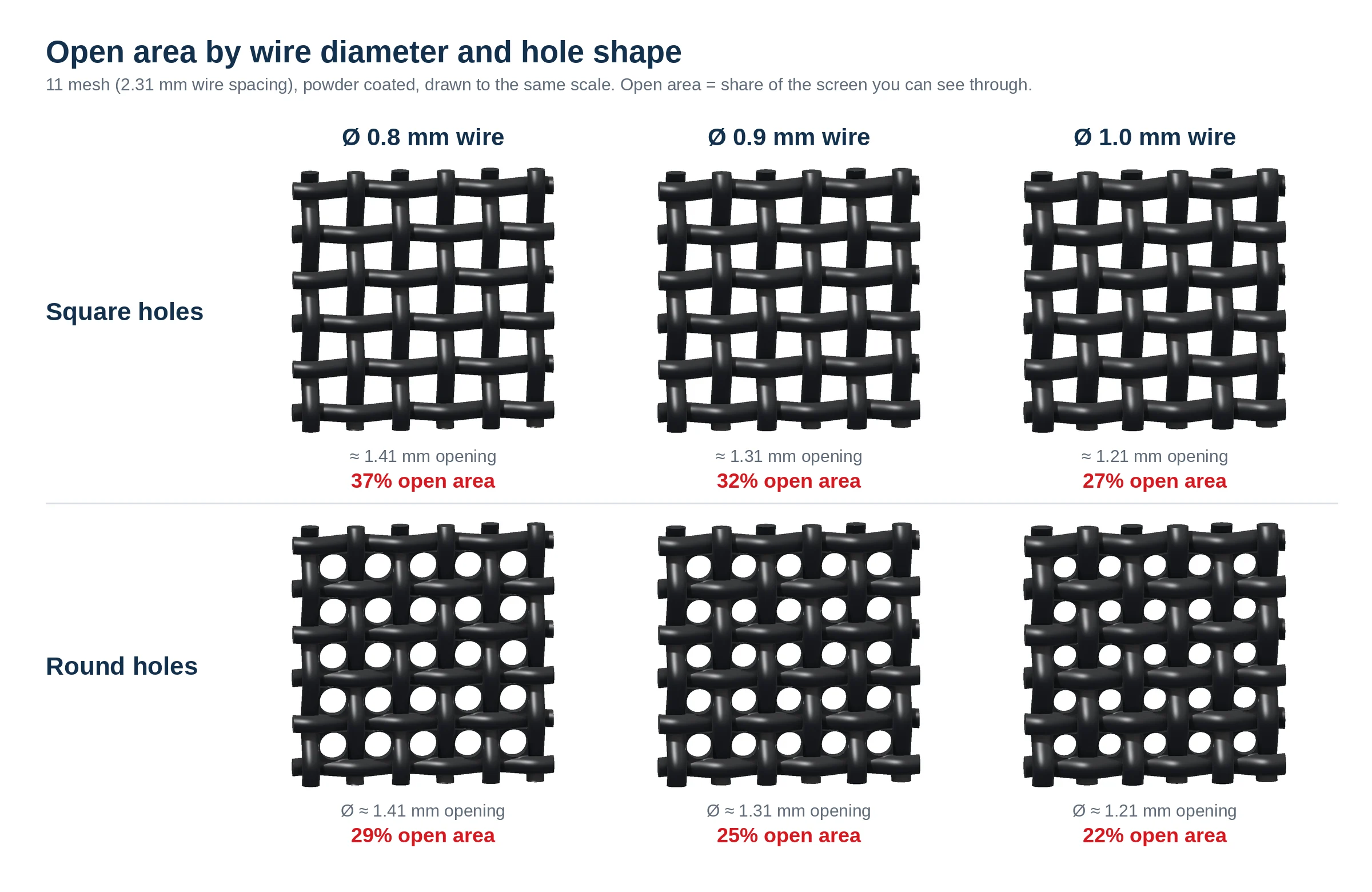
Open area is the share of the screen you can see through. It mostly decides how much light and air the screen lets in. The table shows 11 mesh (2.31 mm wire spacing) in the three most common wire diameters.
| Wire diameter | Bare mesh: opening / open area | Square holes: opening / open area | Round holes: opening / open area |
|---|---|---|---|
| 0.8 mm | 1.51 mm / 43% | ≈ 1.41 mm / ≈ 37% | Ø ≈ 1.41 mm / ≈ 29% |
| 0.9 mm | 1.41 mm / 37% | ≈ 1.31 mm / ≈ 32% | Ø ≈ 1.31 mm / ≈ 25% |
| 1.0 mm | 1.31 mm / 32% | ≈ 1.21 mm / ≈ 27% | Ø ≈ 1.21 mm / ≈ 22% |
How these figures are calculated: wire spacing = 25.4 mm ÷ 11. Opening = wire spacing − coated wire diameter. Square open area = (opening ÷ wire spacing)². Round open area = square open area × π/4. Coated figures assume about 0.05 mm of powder on each side of the wire. Real coatings vary, so treat the coated values as close estimates.
Two points stand out. Going from 0.8 mm to 1.0 mm wire costs about 10 points of open area. Choosing round holes instead of square costs about 6–8 points on each wire size. A 0.8 mm round-hole mesh lets through less light than a 0.9 mm square-hole mesh.
Airflow, light, insects and security compared
| Square holes | Round holes | |
|---|---|---|
| Light | More light; about 37% open area on 0.8 mm wire | About 21% less light than square holes on the same mesh |
| View through the screen | Clearer view; the wires look thinner | Darker; the solid area around each hole is larger |
| Airflow | Better ventilation | Lower; less open area means more resistance to air |
| Insects | Same narrowest gap as round holes | Same narrowest gap; the larger diagonal gap of a square hole is closed |
| Cut and impact resistance | Set by wire diameter, stainless steel grade and the screen system | Same; the steel wire is identical |
| Appearance | Fine, regular square grid | Rows of round holes, similar to a perforated sheet |
Light and view. Open area is roughly the share of light that passes straight through, so round holes make the screen noticeably darker. The extra solid area at each wire crossing also makes the mesh more visible from inside, which matters for windows with a view.
Airflow. Air passes through the openings, so a smaller open area gives more resistance and less ventilation at the same wind pressure. If ventilation is the main reason for the screen, square holes are the better choice.
Insects. Whether an insect gets through depends on the narrowest gap. A round hole is as wide as the square hole it replaces, so both finishes stop the same insects. Round holes close only the diagonal of the square, which is about 1.4 times the side. In practice, mesh count and wire diameter matter far more for insect protection than hole shape.
Security. The stainless steel wire inside the coating is the same in both finishes. Cut and impact resistance come from the wire diameter, the grade (304 or 316) and the weave. Hole shape does not make the mesh stronger or weaker.
In Australia, security door and window screens are assessed as complete products under the AS 5039 series: AS 5039.1:2023 sets the performance requirements, AS 5039.3:2023 sets the test methods (impact, jemmy, pull, probe and knife shear) and AS 5039.2:2024 covers installation. These parts replace the older AS 5039-2008, AS 5041-2003 and AS 5040-2003. Testing applies to the finished screen, including the frame, the way the mesh is held in it and the locks, not to the mesh on its own.
How to tell square holes from round holes
- Hold the mesh up to the light. Square holes show a regular square grid; round holes show rows of round dots of light. The difference is clear to the eye.
- Compare samples side by side. For the same wire diameter, the round-hole sample looks darker overall.
- Ask for the finish in writing. State “square hole” or “round hole” on the order and approve a sample before production. Both are produced to order, so the finish should never be a surprise.
Which one should you choose?
Choose square holes when light, a clear view or ventilation matters most: windows, balconies and patios, and markets where a “see-through” screen is the selling point.
Choose round holes when your market is used to the traditional round-hole look, or your customers prefer it and accept a darker screen with less airflow.
Choose a heavier wire, not a heavier coat, when you need more strength. 0.9 or 1.0 mm wire with square holes adds steel while keeping more open area than 0.8 mm wire with round holes.
What to include in your enquiry
- Stainless steel grade: 304 or 316 (316 for coastal areas and around pools)
- Mesh count and wire diameter, e.g. 11 mesh × 0.8 mm
- Hole finish: square hole or round hole
- Colour: black, grey or white
- Roll width (0.6–1.5 m) and length (31.5 m standard), or cut sheet sizes
- Quantity and destination port
- Whether you need a sample before production
FAQ
Is round-hole security mesh stronger than square-hole mesh?
No. Both use the same stainless steel wire and weave; the difference is the powder coating. Strength comes from the wire diameter, the steel grade and the complete screen system.
How much less light does round-hole mesh let through?
About 21% less than square holes on the same mesh, because a round hole covers about 78.5% of a square hole of the same width. On 11 mesh with 0.8 mm wire, that is about 29% open area instead of about 37%.
Does round-hole mesh keep out more insects?
Not noticeably. The width across a round hole is the same as the side of the square hole, so both stop the same insects. Mesh count and wire diameter matter much more.
Can I order either finish?
Yes. We produce both finishes to order, each in a single powder coat. State the finish on your order and approve a sample first.
Does the AS 5039 standard cover the mesh alone?
No. AS 5039.1:2023 and the test methods in AS 5039.3:2023 apply to complete security door and window screens, including the frame, mesh retention and locks. The mesh is one part of the system.
Need security screen mesh in square-hole or round-hole finish? Send us your specification →
Sources
- Standards Australia, AS 5039.1:2023 Security door and window screens — Classification and performance (supersedes AS 5039-2008). Listing: https://www.intertekinform.com/en-us/standards/as-5039-1-2023-1344120_saig_as_as_3342511/
- Standards Australia, AS 5039.2:2024 Security door and window screens — Installation (supersedes AS 5040-2003). Listing: https://shop.standards.ie/en-ie/standards/as-5039-2-2024-1375244_saig_as_as_3435229
- Standards Australia, AS 5039.3:2023 Security door and window screens — Methods of test (supersedes AS 5041-2003). Listing: https://shop.standards.ie/en-ie/standards/as-5039-3-2023-1344119_saig_as_as_3342509
- Test names (impact, jemmy, pull, probe, knife shear): ASI Security, Australian Standards for Security Screens: https://asisecurity.com.au/australian-standards-for-security-screens/
- Open area figures: calculated by Tongwei from mesh geometry (method shown above).